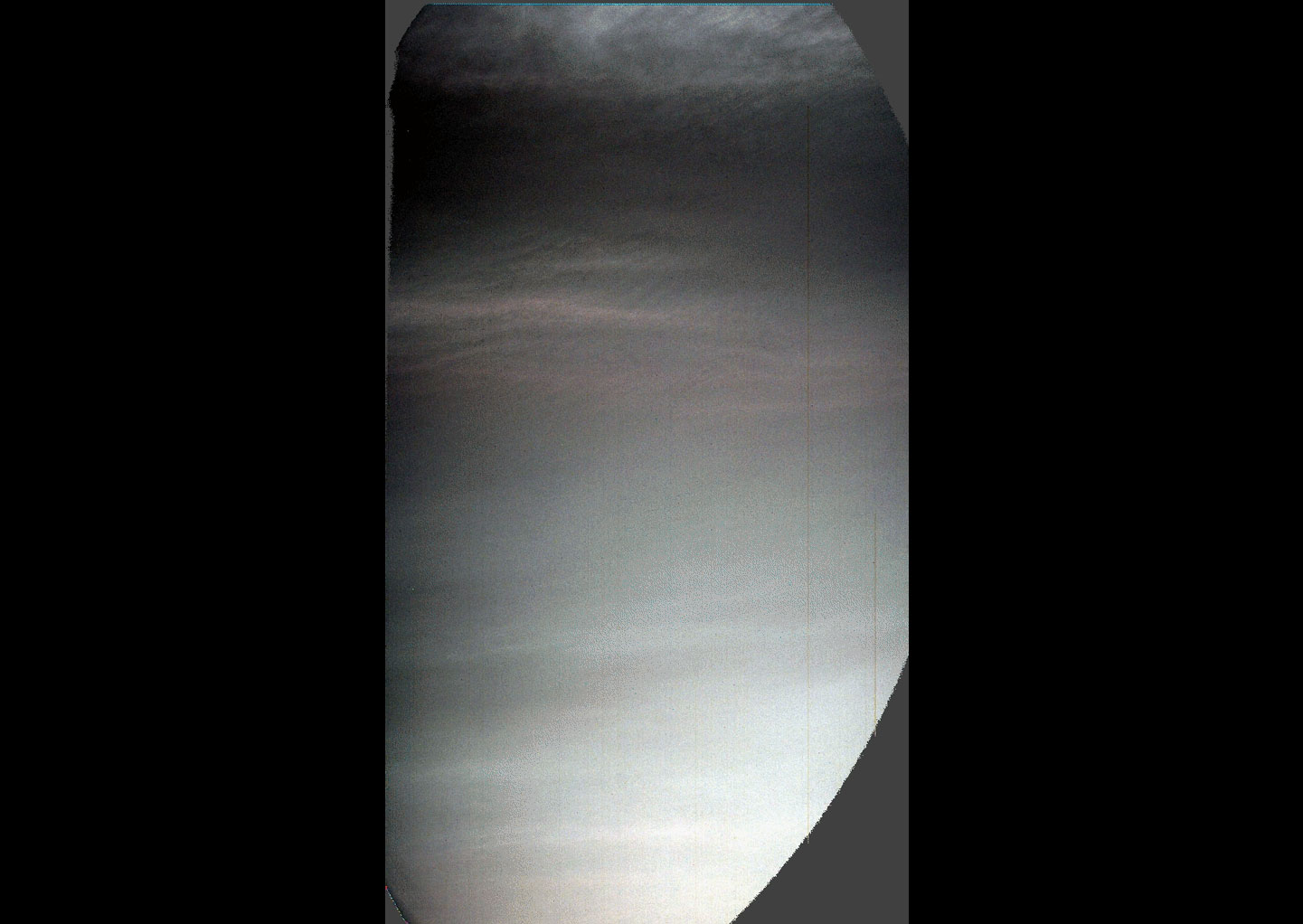
Mark Lemmon, an atmospheric scientist with the Space Science Institute in Boulder, Colorado, led a summarizing Curiosity’s first two seasons of twilight cloud observations, which published late last year in Geophysical Research Letters. “I’ll always remember the first time I saw those iridescent clouds and was sure at first it was some color artifact,” he said. “Now it’s become so predictable that we can plan our shots in advance; the clouds show up at exactly the same time of year.”
Each sighting is an opportunity to learn more about the particle size and growth rate in Martian clouds. That, in turn, provides more information about the planet’s atmosphere.
Cloud Mystery
One big mystery is why twilight clouds made of carbon dioxide ice haven’t been spotted in other locations on Mars. Curiosity, which landed in 2012, is on Mount Sharp in Gale Crater, just south of the Martian equator. Pathfinder landed in Ares Vallis, north of the equator. rover, located in the northern hemisphere’s Jezero Crater, hasn’t seen any carbon dioxide ice twilight clouds since its 2021 landing. Lemmon and others suspect that certain regions of Mars may be predisposed to forming them.
👇👇👇👇 [Google Ads]
A possible source of the clouds could be gravity waves, he said, which can cool the atmosphere: “Carbon dioxide was not expected to be condensing into ice here, so something is cooling it to the point that it could happen. But Martian gravity waves are not fully understood and we’re not entirely sure what is causing twilight clouds to form in one place but not another.”
Mastcam’s Partial View
The new twilight clouds appear framed in a partially open circle. That’s because they were taken using one of Mastcam’s two color cameras: the left 34 mm focal length Mastcam, which has a that is stuck between positions. Curiosity’s team at NASA’s Jet Propulsion Laboratory in Southern California remains able to use both this camera and the higher-resolution right 100 mm focal length camera for color imaging.
The rover recently wrapped an investigation of a place called Gediz Vallis channel and is on its way to a new location that includes — fractures formed by groundwater that look like when viewed from space.
👇👇👇👇 [Google Ads]
More recently, Curiosity visited an impact crater nicknamed “,” capturing it in images and studying the composition of rocks around it. The crater, 67 feet (20 meters) in diameter, is shallow and has lost much of its rim to erosion, indicating that it likely formed many millions of years ago. One reason Curiosity’s science team studies craters is because the cratering process can unearth long-buried materials that may have better preserved organic molecules than rocks exposed to radiation at the surface. These molecules provide a window into the ancient Martian environment and how it could have supported microbial life billions of years ago, if any ever formed on the Red Planet.
More About Curiosity
Curiosity was built by NASA’s Jet Propulsion Laboratory, which is managed by Caltech in Pasadena, California. JPL leads the mission on behalf of NASA’s Science Mission Directorate in Washington. Malin Space Science Systems in San Diego built and operates Mastcam.
For more about Curiosity, visit:
👇👇👇👇 [Google Ads]
Feed By Today and Features – NASA's Jet Propulsion Laboratory
👇👇👇👇 [Google Ads]