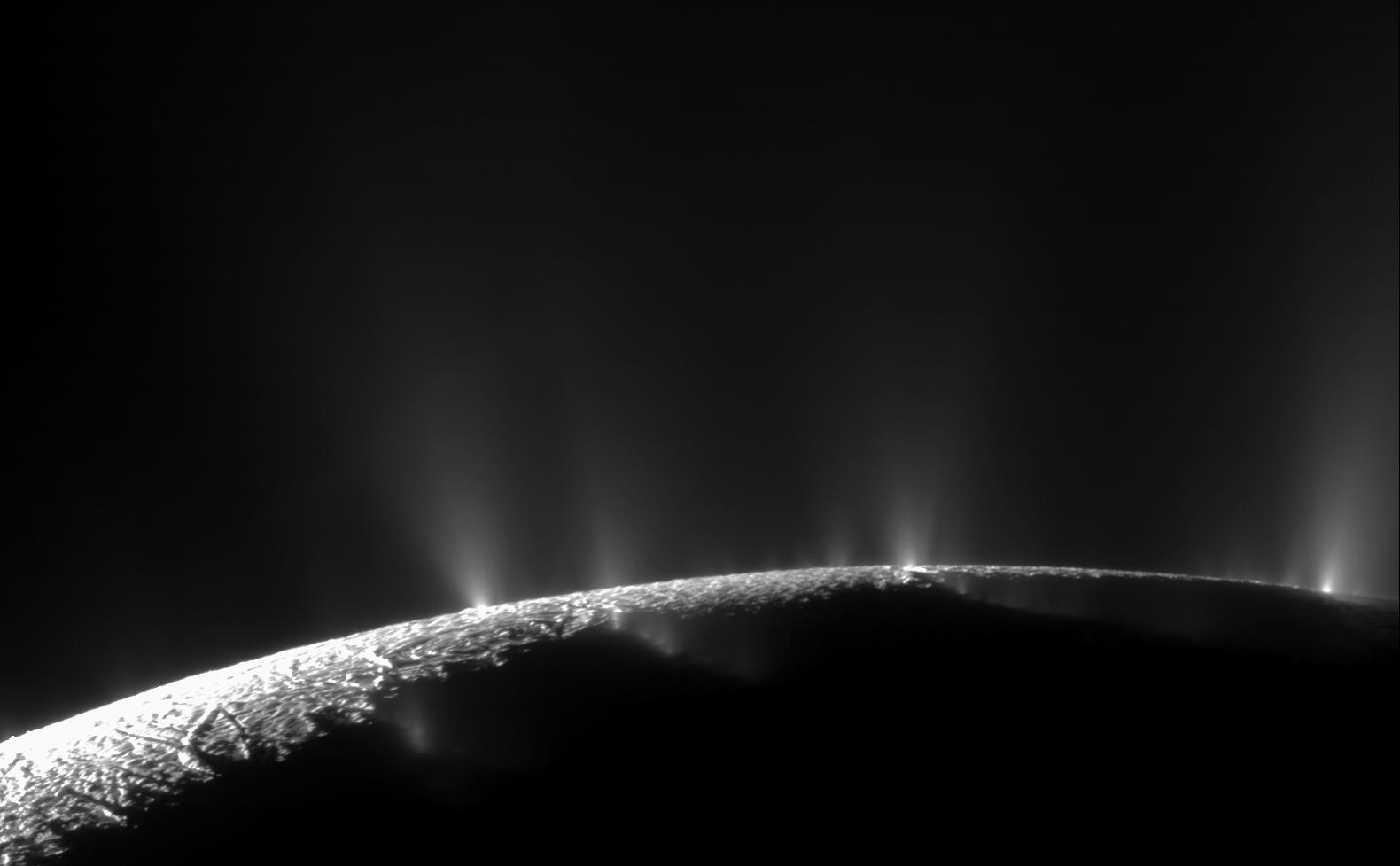
Scientists knew from previous Cassini data-mining that nitrogen- and oxygen-bearing organic compounds were present in particles from Saturn’s E ring, a faint, wide outer band around the planet fed by the icy material that fans out from Enceladus’ plumes. But the new research analyzed ice grains from a moon plume itself — in other words, grains found closest to their subsurface origin.
“These molecules we found in the freshly ejected material prove that the complex organic molecules Cassini are not just a product of long exposure to space, but are readily available in Enceladus’ ocean,” said coauthor Frank Postberg, also of Freie Universität Berlin.
Fast and fruitful
The data was collected and sent to Earth in 2008, when ice particles impacted Cassini’s Cosmic Dust Analyzer instrument. Besides being directly sourced from a plume, the ice grains had another thing going for them: They’d been smashed to smithereens as they struck the instrument during the spacecraft’s fast fly-through at 11 miles per second (about 18 kilometers per second relative to the moon).
👇👇👇👇 [Google Ads]
The energy of the impact vaporized the ice grains and ionized a substantial fraction of them. Those ions were then analyzed by the instrument’s mass spectrometer, which examined their chemical makeup.
The study’s authors were able to analyze the tiniest of fragments — smaller than a thousandth of a millimeter, smaller even than a flu virus — and identify organic compounds they hadn’t seen before in plume particles.
The newly detected compounds included those from the aliphatic and cyclic ester and ether families, some with double bonds in their molecular structures. Together with the confirmed aromatic, nitrogen- and oxygen-bearing compounds, these compounds can form the building blocks to support chemical reactions and processes that could have led to more complex organic chemistry — the kind that is of interest to astrobiology and narrows the focus of where we search for life in the solar system.
👇👇👇👇 [Google Ads]
After flying through the plume, the spacecraft, managed by NASA’s Jet Propulsion Laboratory in Southern California, explored the complex Saturn system for nearly another decade.
More about Cassini
The Cassini-Huygens mission was a cooperative project of NASA, ESA (European Space Agency), and the Italian Space Agency. A division of Caltech in Pasadena, JPL managed the mission for NASA’s Space Mission Directorate in Washington and designed, developed, and assembled the Cassini orbiter.
To learn more about Cassini, visit:
👇👇👇👇 [Google Ads]
Feed By Today and Features – NASA's Jet Propulsion Laboratory
👇👇👇👇 [Google Ads]
You Might Also Like

New Survey: 79% of survey respondents overlook their health needs during the holidays; find the holidays more stressful than tax season

New Love for Older Adults: Don’t Make the Same Financial Mistakes

NASA-Funded Studies Explain How Climate Is Changing Earth’s Rotation