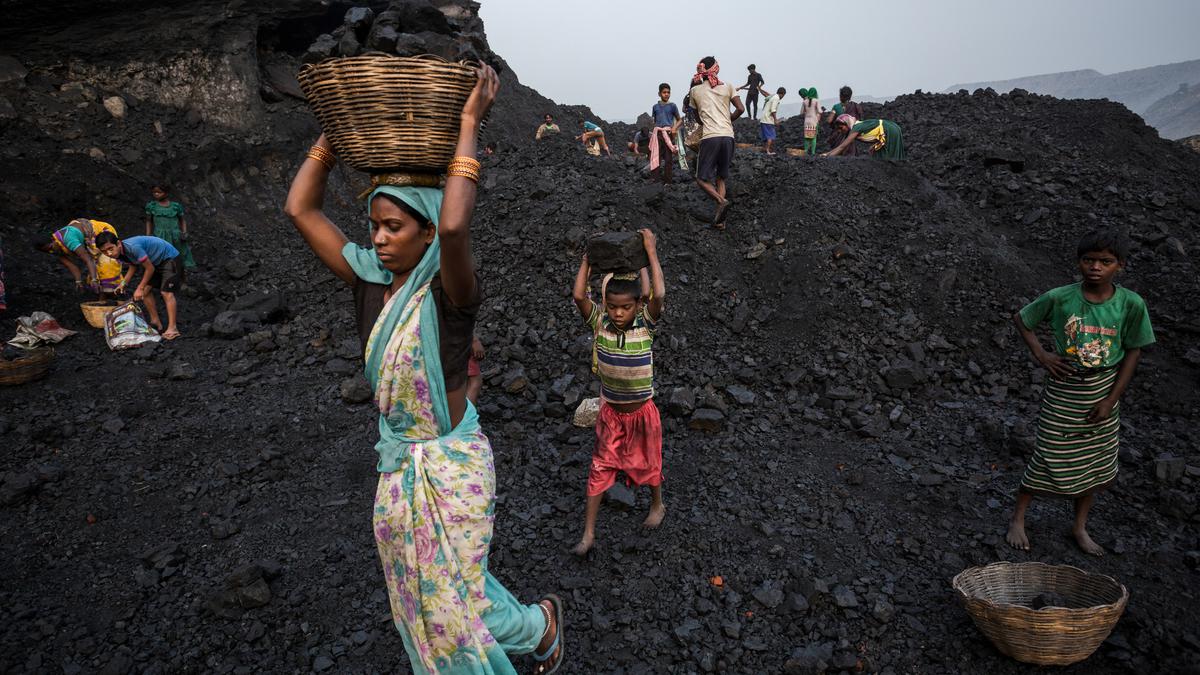

In Jharia coal mine area, many families are involved in illegal coal mining, along with their children. They are so poor that they are controlled by the mafia, and are forced to work in the toxic and risky environment.
| Photo Credit: Getty Images
India’s environmental crisis remains unaddressed partly because the expanding middle class settles for private solutions that come at a cost to the environment, and the poor, argues Johaness Urpelainen in his new book, Energy and Environment in India. For a majority of consumers, diesel generators provide reliable source of energy; groundwater pumps ensure water supply; air purifiers counter air pollution, and air conditioners work against summer heat. The prevalence of these market-led private solutions reduces political pressure to act.
“When consumers can find a private, if perhaps expensive, solution to a government failure, their interest in systematic solutions through government policy is diminished,” he says. But India’s energy consumption pattern is no longer a domestic issue; there are global repercussions on how the world’s most populous country tackles environmental concerns. Its over-reliance on coal as a source of energy and its commitment to attain net zero emission by 2070 show a contradicting picture.
👇👇👇👇 [Google Ads]

A coal-fired power station.
| Photo Credit:
Getty Images
👇👇👇👇 [Google Ads]
Uneasy transition
Transition from a coal-based power sector to a renewables-based energy sector is both feasible and desirable to mitigate climate change while delivering energy security, and reducing air pollution. However, regional variations in energy production and consumption are too huge to provide a clear response. Urpelainen, a Professor of Energy, Resources, and Environment at the Johns Hopkins School of Advanced International Studies, draws a comprehensive picture of the country’s complicated environmental situation to assert that only by reinforcing current policies can sizeable gains be reaped by 2030. Curiously, and somewhat paradoxically, India has laws but lacks order to implement them.
India has started on a low-carbon pathway but any approach to accelerate it at the cost of economic development is off the table. In this slim volume, Urpelainen has painted the complex environmental scenario of a country that is both full of potential as well as afflicted by greater problems. However, within it lies the scope for the country to claim leadership role in global environmental policies. For this, the country will need to ensure that its reduced water and carbon footprints become the guiding spirit of sustainable development, with a strong focus on equity.
👇👇👇👇 [Google Ads]

Local villagers in Dhanbad are carrying coal from the coal mine for their livelihood as they do not have any other source of income.
| Photo Credit:
Getty Images
👇👇👇👇 [Google Ads]
Global repercussions
The global pivot toward India is driven by an explosive combination of population growth, economic performance, poverty and chronic institutional handicaps, he points out. In an ideal scenario, India would continue making rapid progress toward eradicating poverty, but in a sustainable manner by taking advantage of clean technology. Alternatively, India could fail to grow because of its mounting social problems, which would be disastrous for a large majority of the people. The third possibility, points out Urpelainen, is that the Indian economy would grow, but the growth trajectory would be unsustainable and the ensuing environmental destruction would drive the country and the world into a crisis.

What is clear is the compelling need for the political leadership to formulate effective policies, and to resist the temptation to exempt the mighty corporations from strict environmental rules. The book convincingly argues that to produce fair, equitable, and sustainable outcomes for almost two billion Indians, the country must strive for a sustainable future through democratic norms. It’s a great reference book to understand India’s domestic issues and its role in the global energy and environment politics.
👇👇👇👇 [Google Ads]
👇👇👇👇 [Google Ads]
Views: 769
You Might Also Like

Indonesian transgender models shine spotlight on pollution with plastic fashion

Corridor H drilling permit legality questioned, environmental impact feared

Indonesian Transgender Models Shine Spotlight on Pollution With Plastic Fashion