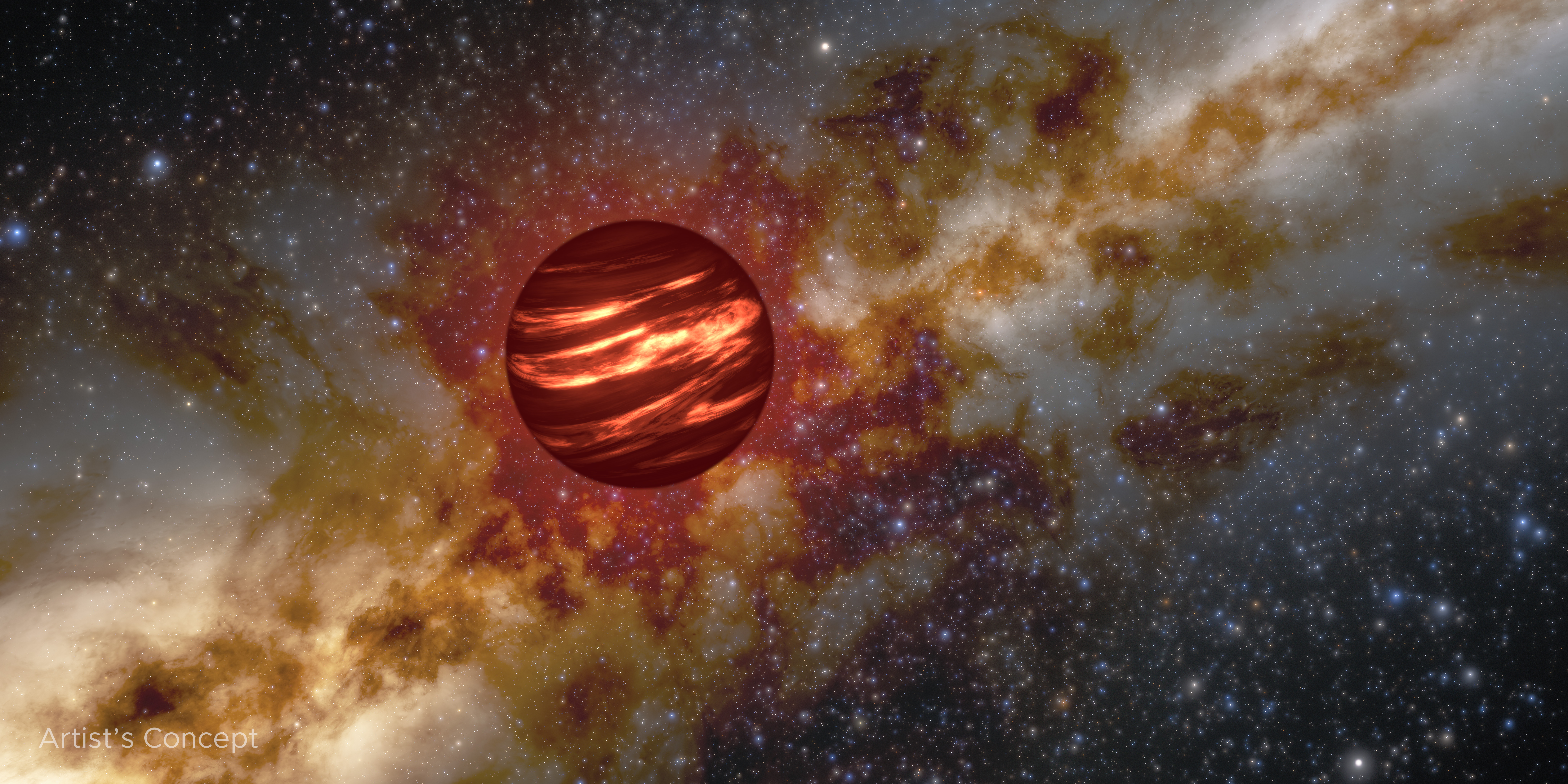
So why is silane in The Accident? The study authors surmise it is because far less oxygen was present in the universe when the ancient brown dwarf formed, resulting in less oxygen in its atmosphere to gobble up all the silicon. The available silicon would have bonded with hydrogen instead, resulting in silane.
“We weren’t looking to solve a mystery about Jupiter and Saturn with these observations,” said JPL’s Peter Eisenhardt, project scientist for the WISE (Wide-field Infrared Survey Explorer) mission, which was later repurposed as NEOWISE. “A brown dwarf is a ball of gas like a star, but without an internal fusion reactor, it gets cooler and cooler, with an atmosphere like that of gas giant planets. We wanted to see why this brown dwarf is so odd, but we weren’t expecting silane. The universe continues to surprise us.”
Brown dwarfs are often easier to study than gas giant exoplanets because the light from a faraway planet is typically drowned out by the star it orbits, while brown dwarfs generally fly solo. And the extend to all kinds of planets, including ones outside our solar system that might feature potential signs of habitability.
👇👇👇👇 [Google Ads]
“To be clear, we’re not finding life on brown dwarfs,” said Faherty. “But at a high level, by studying all of this variety and complexity in planetary atmospheres, we’re setting up the scientists who are one day going to have to do this kind of chemical analysis for rocky, potentially Earth-like planets. It might not specifically involve silicon, but they’re going to get data that is complicated and confusing and doesn’t fit their models, just like we are. They’ll have to parse all those complexities if they want to answer those big questions.”
More about WISE, Webb
A division of Caltech, JPL managed and operated WISE for NASA’s Science Mission Directorate. The mission was selected competitively under NASA’s Explorers Program managed by the agency’s Goddard Space Flight Center in Greenbelt, Maryland. The NEOWISE mission was a project of JPL and the University of Arizona in Tucson, supported by NASA’s Planetary Defense Coordination Office.
For more information about WISE, go to:
👇👇👇👇 [Google Ads]
The James Webb Space Telescope is the world’s premier space science observatory, and an international program led by NASA with its partners, ESA (European Space Agency) and CSA (Canadian Space Agency).
To learn more about Webb, visit:
👇👇👇👇 [Google Ads]
Feed By Today and Features – NASA's Jet Propulsion Laboratory
👇👇👇👇 [Google Ads]