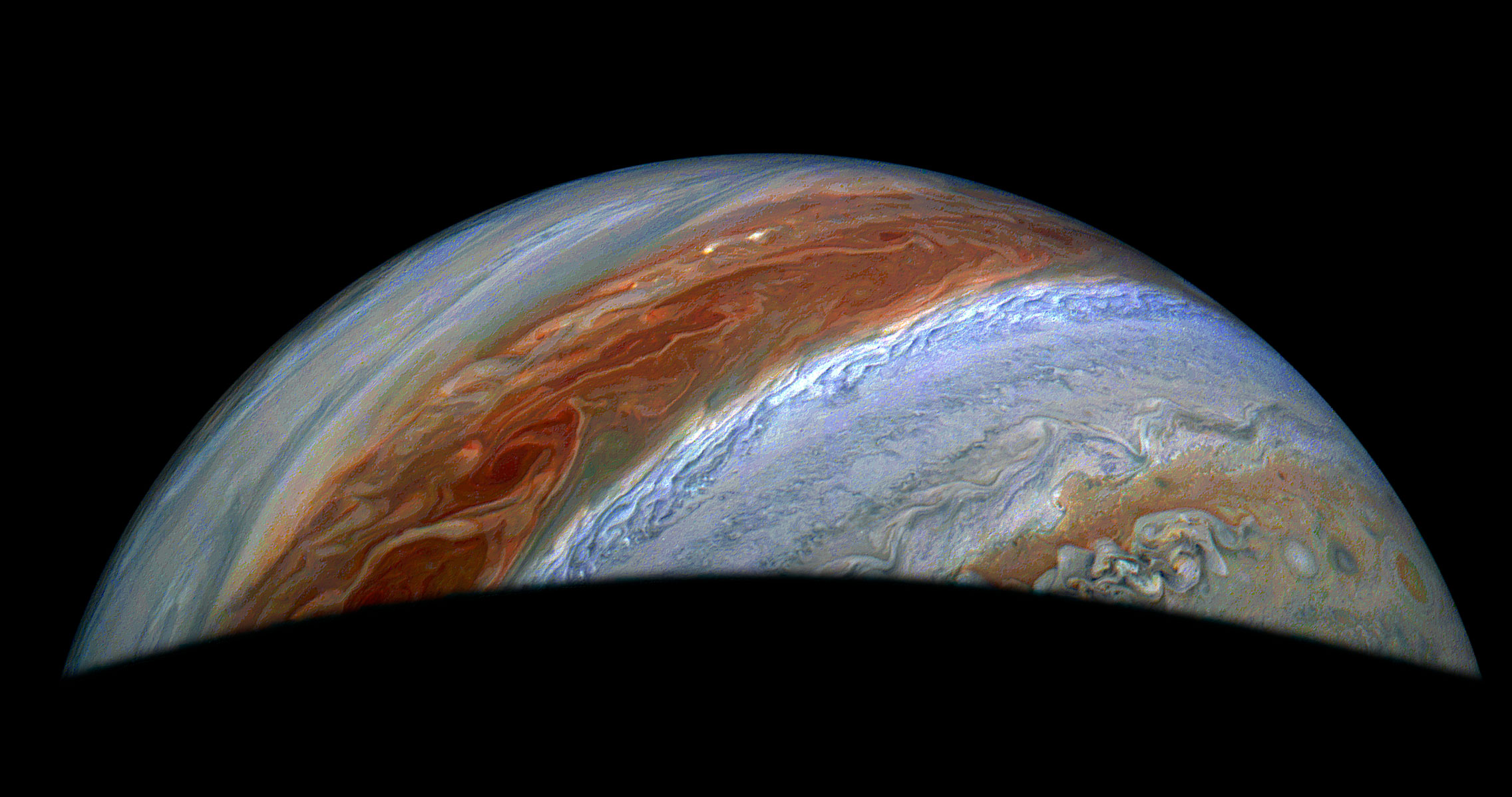
Polar Cyclones
The team’s recent findings also focus on the cyclones that haunt Jupiter’s north. Years of data from the visible light imager and JIRAM have allowed Juno scientists to observe the long-term movement of Jupiter’s massive northern polar cyclone and the eight cyclones that encircle it. Unlike hurricanes on Earth, which typically occur in isolation and at lower latitudes, Jupiter’s are confined to the polar region.
By tracking the cyclones’ movements across multiple orbits, the scientists observed that each storm gradually drifts toward the pole due to a process called “beta drift” (the interaction between the and the cyclone’s circular wind pattern). This is similar to how hurricanes on our planet migrate, but Earthly cyclones break up before reaching the pole due to the lack of warm, moist air needed to fuel them, as well as the weakening of the Coriolis force near the poles. What’s more, Jupiter’s cyclones cluster together while approaching the pole, and their motion slows as they begin interacting with neighboring cyclones.
“These competing forces result in the cyclones ‘bouncing’ off one another in a manner reminiscent of springs in a mechanical system,” said Yohai Kaspi, a Juno co-investigator from the Weizmann Institute of Science in Israel. “This interaction not only stabilizes the entire configuration, but also causes the cyclones to oscillate around their central positions, as they slowly drift westward, clockwise, around the pole.”
👇👇👇👇 [Google Ads]
The new atmospheric model helps explain the motion of cyclones not only on Jupiter, but potentially on other planets, including Earth.
“One of the great things about Juno is its orbit is ever-changing, which means we get a new vantage point each time as we perform a science flyby,” said Bolton. “In the , that means we’re continuing to go where no spacecraft has gone before, including spending more time in the strongest planetary radiation belts in the solar system. It’s a little scary, but we’ve and are learning more about this intense environment each time we go through it.”
More About Juno
NASA’s Jet Propulsion Laboratory, a division of Caltech in Pasadena, California, manages the Juno mission for the principal investigator, Scott Bolton, of the Southwest Research Institute in San Antonio. Juno is part of NASA’s New Frontiers Program, which is managed at NASA’s Marshall Space Flight Center in Huntsville, Alabama, for the agency’s Science Mission Directorate in Washington. The Italian Space Agency funded the Jovian InfraRed Auroral Mapper. Lockheed Martin Space in Denver built and operates the spacecraft. Various other institutions around the U.S. provided several of the other scientific instruments on Juno.
👇👇👇👇 [Google Ads]
More information about Juno is at:
Feed By Today and Features – NASA's Jet Propulsion Laboratory
👇👇👇👇 [Google Ads]
Views: 790
You Might Also Like

Gill-Jaiswal Emulate Rohit-Rahane’s Unwanted 7-Year-Old Opening Record

NASA’s Curiosity Searches for New Clues About Mars’ Ancient Water

NASA: New Study on Why Mars Is Red Supports Potentially Habitable Past